The Victorian Turkish Baths Project logo


Nothing but a load of hot air:
some problems, conflicts, and controversies
arising during the development
of the Victorian Turkish bath


This is a single frame, printer-friendly page taken from

one of the linked parts of an article published on Malcolm Shifrin's website

Victorian Turkish Baths: their origin, development, and gradual decline


Original illustrated page with notes and links


6: Class

David Urquhart, who had seen people of all classes mixing freely in the baths of Constantinople, believed that the Turkish bath could break down class barriers.

No barrier of ceremony, of pride, or of habit, is so great as that of filth which, in these times, especially in large towns, separates the poor from the rich, as if they were not members of the same state, but, as Disraeli has phrased it, ‘the two nations.’

But British middle class officialdom was not at all happy with such an approach. Many medical officers of health and local politicians, for example, were just as prejudiced against the provision of inexpensive Turkish baths for the working classes as the doctors who feared for their livelihood.

It was believed, almost certainly incorrectly, that the original Baths and Wash-houses Acts of 1846 and 7 precluded the provision of publicly financed Turkish baths. London didn’t get one till 1905, but several provincial towns built them with impunity—others more cautiously called them vapour baths, which were permitted.

The majority of early Turkish baths were, therefore, commercial establishments. While publicly financed baths were not permitted to charge more than 2d for a second class vapour bath, no commercial concern could break even, let alone make a profit, at that price.

As a result, Turkish baths were rarely built in the poorer areas where they were most needed. This can be seen clearly in London if we superimpose establishments on Booth’s 1889 poverty map; preferred locations were more often adjacent to railway stations used by commuters travelling home to the suburbs.

Working class bathers faced another barrier. When, in 1864, Bury Council unanimously decided to open their Turkish baths for a few hours on Sunday mornings, there was an outcry.

‘J.W.A.’ wrote to the Bury times that ‘it was a disgrace to the town’ and asked bathers to boycott the baths on Sundays. Letters for and against followed, one supporting the council even coming from outside the town. William Cooper wrote,

We have a Turkish Bath in Rochdale which is open on a Sunday, and the Christians here—who are I suppose as good as the Bury Christians—make no objection. And why should they? They are not compelled to go.

After several weeks the correspondence was closed, but the baths remained open.

Yet over twenty years later, pressure from Church and Chapel prevented William Bishop’s Putney baths from opening on Sunday—the only day, he argued, the working classes had sufficient time to use them.


7: Charges of indolence and effeminacy


The original page includes thumbnail pictures which can be enlarged.
Enlargements can also be found at:

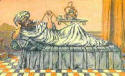
Outer cooling room of the bath: near Psamatia Kapousi, Constantinople 

Lower Dartmouth Street Cottage Baths, in Birmingham

Booth's Poverty Map, with location of Turkish baths

Top of the page


Single frame versionsof all text
pages (and from them, all pictures)
can be reached from the

Site map

Complete versions
of all other pages
can be reached from the

Home Page

Comments and queries are most welcome and can be sent to:
malcolm@victorianturkishbath.org

The right of Malcolm Shifrin to be identified as the author of this work has been asserted by him
in accordance with the Copyright, Designs and Patents Act 1988