|
||||
|
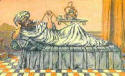
Some advocates of the bath, even Dr Haughton, first Manager of the Oriental Baths in Liverpool, were not convinced of the value of shampooing or massage: One thing more is required before the bath can be brought within the reach of the public, viz, the costly, tedious, and effeminate custom of shampooing must be totally got rid of, except when prescribed as a therapeutic agent. But shampooing remained an important component of the Turkish bath. Not until the very end of the century was any suggestion made, and then in the most discreet manner, that in a few establishments, massage may have had unhealthy connotations. The other moral issue concerned nudity. Erasmus Wilson, in his book The Eastern, or Turkish Bath, writes: ...a costume is indispensable. Without a costume in the presence of others, the bath is not the bath--it is an evil, and as an evil it should be suppressed with the utmost severity. but Mr Jagger, who advised us earlier on the use of the shower, has a rather more representative view: Some object to the Bath, because of the time they are liable to be seen in a state of comparative nakedness. This seems to spring from the too common notion of no sin if the world does not see it. We think it a piece of over-fastidiousness to shrink from being seen by the same sex, when there is no special reason for so doing. The vicious and the unfortunate may be pardoned if they try to hide the evidence of past folly, or of natural deformity; but the healthy, well-formed man, need not be ashamed to be seen by his neighbour. Usually bathers were partially covered by towels, though most swam in the plunge pool in the nude. At the London Hammam, modesty tents were lowered over bathers as they left the pool. |
||||
|
Earliest photograph of a massage? Towel tent in use at the Jermyn Street Hammam
|
||||
![]() |
All
complete pages, |
Printer-friendly single frame |
||
|
|
|
|||
|
Victorian Turkish Baths: their origin, development, and gradual decline |
||||
|
Comments and queries are most welcome and can be sent to: |
||||
|
The
right of Malcolm Shifrin to be identified as the author of this work has been asserted by him |
||||