‘Since
not everyone’, wrote Trollope,
‘ has taken a Turkish bath in Jermyn Street we will give the
shortest possible description of the position.’—which
he then proceeds to do over the next four pages of the short story
which opens in David Urquhart’s fashionable London Hammam.
The Hammam
was, perhaps, the most important of the more than 600 Victorian
Turkish baths which I have so far identified. Barely half a dozen of
these baths remain open today, so it is not surprising that there is
much confusion as to what a Turkish bath actually is. I hope,
therefore, you will forgive my following in Trollope’s footsteps by
first indicating what I mean, and what the Victorians meant by the
term. And if my description is rather less stylish than his, it will
at least be more concise.
The
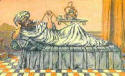
Turkish bath, then, is a type of bath in which the bather sweats, in a
room which is heated by hot DRY air, and it is this use of DRY air
which distinguishes the Turkish bath from the medicated vapour bath,
or the steam baths usually known as Russian baths, which had been
available in the British Isles well before 1856.
Its second
distinguishing feature is that bathers progress through a series of
increasingly hot rooms, usually three, until they sweat profusely,
often repeating the process, with possible diversions in the direction
of showers or a short dip in the cold plunge pool.
This
leisurely perambulation is followed by a massage and full body wash,
these last two processes, taken together, being known to Victorians as
shampooing.
The
final part of the Turkish bath—no less important than anything which
precedes it—is a longish period of relaxation in the cooling room.
So
we see, in four sentences, that there are several stages in the taking
of a Turkish bath.
‘Stages’
is the word I normally use when describing the bath, but on this occasion, a
self-questioning double-take suggested that it might be worth finding out
whether the word was used by Victorians in this context and,
if so, in what sense.
2.
Urquhart's performance