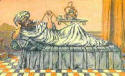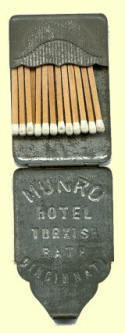
Before
1856, any knowledge of Turkish baths came from published accounts of
travellers who had visited Turkey, the Maghreb, or other areas where
Islamic culture was, or had been, predominant. And, as Patrick Connor
has written, a visit to the baths was, in many 19th century travel
books, a literary set-piece which often took on ‘a
self-conscious, tongue-in-cheek tone’
However,
both the anonymous author of Strictures on the cleanliness of the
English and, a few years later, the former diplomat David Urquhart
were, in my view, quite different from others who wrote of the bath.
Different because their agenda was different.
To them,
the Turkish bath was not a curious custom, related merely to interest
and entertain their readers; it was a model, to be admired and, most
important, to be copied in order to raise British ideas of personal
cleanliness up to Turkish standards—a novel concept for a nation of
empire builders busily introducing Christianity and the benefits of
British rule to the poor foreigner.
At a time,
then, when the majority of Victorians had no indoor running water, let
alone any experience of taking what we think of as an ordinary bath,
these two writers argued that a network of public Turkish baths should
be built at public expense. Of the two, only Urquhart achieved even a
modicum of success.
In 1850, he
described visits to Moorish and Turkish baths in his travel book, The
Pillars of Hercules—a travel book (it must be said) in which the
author did not eschew flowery language, nor balk at lengthy
descriptions. But his two chapters on the bath were written not to
entertain, but to proselytize and, at public meetings, he would quote
from them at length.
For
Urquhart was a consummate publicist, who instinctively understood that
a performance—in the words of a much later writer in a slightly
different context—a performance was,
a
way of appealing directly to a large public, as well as shocking
audiences into reassessing their own notions….
How then
did Urquhart describe the Turkish bath?
The
operation consists of various parts: first, the seasoning of
the
body; second, the manipulation of the muscles; third, the
peeling of the epidermis; fourth, the soaping, and the
patient is then conducted to the bed of repose. These are the
five acts of the drama.
Then he
goes on to describe the set:
There
are three essential apartments in the building: a great hall or mustaby,
open to the outer air; a middle chamber, where the heat is moderate;
the inner hall, which is properly the thermae.
And then
the programme:
The
first scene is acted in the middle chamber; the next three in the
inner chamber, and the last in the outer hall. The time occupied is
from two to four hours, and the operation is repeated once a week.
Now the
performance starts:
On
raising the curtain which covers the entrance to the street, you
find yourself in a hall circular, octagonal, or square, covered with
a dome open in the centre…
Urquhart
actually begins the section which follows with the words:
2nd
Act—You now take your turn for entering the inner chamber:
and we find
that his bather has now become part of the performance, and remains so
as he continues through Acts three, four, and five.
Was James
Roose-Evans, I wonder, actually writing inside a Turkish bath while
describing Grotowski’s Theatre of Sources as:
an
attempt to create a genuine encounter between individuals who meet
at first as complete strangers and then, gradually, as they lose
their fear and distrust of each other, move towards a more
fundamental encounter in which they themselves are the active and
creative participants in their own drama of rituals and ceremonials.
For some
bathers, as we shall later see, there were numerous little
rituals and ceremonials.
3.
Theatre and performance