Urquhart’s
encouragement of politeness, of not disturbing other bathers, was
fundamental. Trollope again:
The
true devotee to the Turkish bath will, we think, never speak at all;
but when the speaking is low in tone, just something between a
whisper and an articulate sound, the slight murmuring hum produced
is not disagreeable. We cannot quite make up our mind whether this
use of the human voice be or be not oriental; but we think that it
adds to the mystery, and upon the whole it gratifies.
Even today, one private members’ club in London has strictly enforced
SILENCE
notices in every area of the bath. The London Hammam merely encouraged
quiet behaviour and bathers summoned attendants in the received
eastern manner.
Though
undoubtedly exaggerated, Trollope’s account of the hand-clapping
ritual shows his awareness of the sparks which occasionally flew
between those who enjoyed the bath for its beneficial effect
irrespective of its origin, and those for whom the oriental mystique,
customs and manner were a major fascination.
Very
much will depend on the manner in which he claps his hands, and the
hollowness of the voice in which he calls for water. There should,
we think, be two blows of the palms. One is very weak and poroclaims
its own futility. Even to dull London ears it seems at once to want
the eastern tone. We have heard three given effectively, but we
think that it requires much practice; and even when it is perfect,
the result is that of western impatience rather than of eastern
gravity. No word should be pronounced, beyond that one word,—Water.
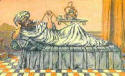
Two
claps of the hand and a call for water, and that repeated with an
interval of ten minutes, are all the external signs of life that the
young Turkish bather may allow to himself while he is stretched upon
his marble couch.
7.
The self-confident bathers