|
Turkish Baths
The Grenville Place Turkish baths were built in 1858 by Dr
Richard Barter. They opened soon after his patients began using the very first
successful modern Turkish baths at St Ann's Hill, his hydropathic establishment in Blarney.
Barter's first experimental beehive-shaped bath,
built there with David Urquhart in 1856, had not been successful.
He therefore sent
his artist nephew, Mr Richard Barter, to Rome to find out how the original
Roman baths were built. This enabled him, later in the year, to
construct a more satisfactory bath, although even this one was still
rather steamy
and liable to burn the soles of the feet.
But Barter
was a perfectionist who continued to work on any problem he
encountered and who took a delight in trying to improve each of his baths throughout
its life. It is reasonable to assume,
therefore, that the baths in Grenville Place were based on those at St
Ann's, with a few minor changes.
In support of this view, it is
interesting to note that as late as 1863—five years after
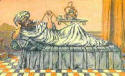
the baths opened—Barter was still using a woodcut image of
a women's hot room at St Ann's in his advertisements for the
Grenville Place baths. The advertisement, like earlier ones,
still took pains to
reassure potential women bathers by indicating that the baths had separate entrances for men and
women, and private dressing rooms rather than communal
changing rooms.
According to Robert Wollaston, speaking in
Cheltenham
after the baths had been open just over six months, '4,376 persons had
used them, and…they had all expressed themselves well pleased.'
An early advertisement for the
baths indicated the opening times and entrance charges. From 11.00 in
the morning till 5.00 in the afternoon admission cost 2/-, or 20/- for
twelve tickets. This was reduced to 1/- (and 10/-) between the hours of
6.00 to 10.00 in both the morning and evening. Children under 10 were
admitted at half price, but only if accompanied by an adult. All these
charges 'included the use of linen', but shampooing cost an additional
6d. On Sundays, the baths were only open between 10.00 and 5.00.
In designing and constructing these baths, Barter
went back to first principles, making good use of his newly acquired
knowledge of the Roman baths visited by his nephew. Unlike the humid
Islamic hammams which Urquhart had visited on his travels in the Maghreb
and the Ottoman Empire, the Roman frigidarium, caldarium,
and laconicum were all heated by dry air channelled under the
floors by means of a hypocaust. This allowed bathers to withstand the
higher temperatures which Barter found to be more effective
therapeutically.
For this reason, he called his Turkish baths 'The
Improved Turkish or Roman Baths'. This had the unfortunate effect that
in some circles he was thought to be arrogant and boastful. But Barter
was not suggesting that he had improved the Turkish hammam, the main
function of which was to be an effective cleansing agent; rather, that the
Roman bath was an improved therapeutic agent, therapy being the main
function of hydropathic establishments.
By the end of 1862, Barter was already dissatisfied
with his Grenville Place baths and opened new ones on 23 February the following year,
just twenty days after the opening of his
Turkish Baths for the Destitute Poor in
Maylor Street.
It is not known how
much rebuilding was actually undertaken at this time but it
seems most likely that only the inside—the baths
themselves—were rebuilt.
During their first ten years, an average of over 18,700 bathers per year
(or well over 360 bathers per week) used the new Grenville Street baths.
It is not known when these
baths closed, but at some stage, probably towards the end of the 19th
century, the building was converted.
The building which still stands on the site today (2006) is now a block
of apartments, as tall as those to be found on its right.
At first glance, it appears to be a completely
different building, but a closer examination suggests that the ground
floor façade is the same, but the top of the original building has been
demolished and replaced by two additional floors.
Closer examination seems to confirm this. The
ground floor door and window openings have been interchanged, the
corners of the front of the building remain rounded at the ground floor
level, and there is a plate, re-affixed to the side of the building,
with the year 1858, when the baths were built, clearly (on the enlarged
image) to be seen.
We are so accustomed these days to
buildings being totally demolished and replaced that it is difficult to
understand the reason for this strange conversion. One possibility is
that, at the time when the conversion was carried out, labour was cheap
while building materials were comparatively expensive, but this is only
conjecture.
This account should be treated as work in progress.
Further research is needed to find out more about the design of these
baths, and whether the current building is, as suggested, a conversion
of the baths.
The original page
includes footnotes, and thumbnail pictures which can be enlarged. All the enlarged images, listed and linked below, can also be printed.
Exterior view of the baths
Exterior view of
converted baths building 2006
1863 advertisement for the baths
Top of the page
|