|
Harrow Road Turkish
baths
This establishment survived,
under a number of different proprietors, for nearly eighty years and was
only closed as a result of a compulsory purchase order prior to the
construction of a flyover leading to the M40 motorway.
The
original proprietor, James Cotton Goudy, opened the Harrow Road Turkish
Baths in 1880. Baths, for men only, were available each weekday from seven
in the morning till ten in the evening and on Saturdays from two in the
afternoon. A Turkish bath cost 2/6d between 9.00 am
and 4.00 pm on weekdays, and 1/6d at all other times. The baths
were closed late in 1885, though why they closed so soon is not known.
They
were bought by an
auctioneer, Thomas Spink, and a Building Society Secretary, Thomas Richards,
who clearly
knew what they doing. They immediately set about refurbishing the bath and
re-opened it on 27
February the following year as a 'Turkish Bathing Establishment for Gentlemen'.
Within
four months they had set up a limited liability company to purchase the
establishment (which was now known as The Paddington Hammam) for the sum
of £2,500. Each of them was
paid £500 in cash and £750 in company shares making them majority
shareholders.
In
1890, the baths were bought by Henry and James Forder Nevill,
and the Paddington Hammam Company ceased trading.
The Nevills already owned four other
establishments including the Charing Cross baths in their recently built
Northumberland Avenue headquarters.
In due course they began to refurbish
their new acquisition so as to make it closer in style and appearance to
their other establishments, although admission charges at Harrow Road were
always less than at their other baths. According to an advert taken from an unknown publication with a pencilled
ascription of 1893, a
Turkish bath still cost the same as it did ten years earlier, 2/6d or
1/6d.
Only the hours when the baths were less expensive had changed, Nevill's charging
the lower rate after
six in the evening. By now the baths were, in the words of the ad,
unapproachable in beauty of design, scientific
ventilation, excellence in heating, comfort in dressing rooms, capability of shampooers, and general attention. Messrs. NEVILL'S
name is a guarantee.
Turkish
baths declined in popularity in the post-World War II years (even more
severely than they had done after World War I) and, having closed
the Charing Cross baths in 1948, Nevill's sold their Harrow Road baths the
following year.
After forty years or so, Mike Young
still remembers the appearance of the baths in great detail, and his
description is all that one might expect from the professional eye of a
production designer for theatre, cinema, and television.
The
baths were built behind a normal shop
front with a plain red door. Set into it was a small square Arabic style grille
through which a bather could be
checked over before being allowed in. Once inside the reception area,
outdoor shoes were removed and stored out of sight, and valuables were
locked in green mini drawer-safes.
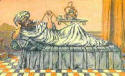
Past
the reception area and through an Arabic arched wooden screen were narrow
bed spaces for changing and resting after the bath. Each had its own light
with a white shade. Otherwise everything in the cubicle was painted dark
red, the colour of the curtain covering its entrance. The ceilings were in
Victorian style Arabic designs made in embossed metal squares; the
fittings were of metal and wood; the walls plastered and painted.
At the
far end of the room there was a void in the ceiling allowing
bathers a view of the
balcony upstairs. Ranged round this were additional cubicles, some of
which were designed to take two beds. Over the void
was a dome housing the main ventilator and from it were
suspended a golden crescent moon and a star—the Islamic symbols
to be found in Turkish baths all over the world.
The
Turkish bath itself was at the far end of the basement, the air
being heated by a stove in the hotter of two interconnected hot rooms. The
walls separating the hot rooms from each other, and from the rest of the
baths, were like shop windows, glass stretching from chairback height to
ceiling. Around each of the hot rooms, below the windows, were white
marble seats with canvas cushions and seat backs to stop bathers burning
themselves. Slung across both doorways, so as to keep the hottest air
inside, were short canvas curtains hanging down to chest height.
Outside
the hot rooms were two slabs for shampooing. There were
overflowing fountains and special metal water scoops that were used by the
shampooers to send torrents of cold water over the marble before and
during a shampoo. There was also a small plunge pool, and a very long and
narrow steam room. The walls of the wet areas were covered with ceramic
tiles, the ceilings were enamelled metal tiles in cream and white, and the whole
basement was quite light and airy.
By all accounts, few improvements were made during
the last years of its existence, when it was known as Tyler's or the
Metro, so that it continued to look like a Nevill's Turkish bath,
though increasingly run-down, until it closed in 1963.
Eric
Wright remembers the Harrow Road Turkish Baths, with its relatively low
admission charge, as being towards the end,
rather downmarket, but very
popular with the night owls who often queued waiting to get in after the pubs
closed … [It was] very much cheaper than finding a
hotel room for anybody passing through London overnight or catching an early train. Not that many people managed to get much
sleep with all that toing and froing going on.
During
the inter-war years, 1918-39, when the number of Turkish baths
declined considerably, the nature of some of those which survived
(especially those in the capital) began to change. Increasingly the baths'
clientele were seen as belonging to one of two groups, self-recognising,
but by no means mutually exclusive.
Those who
were thought of as belonging, in the absence of any contrary evidence,
to the traditional Turkish bath clientele, tended to use the
baths mainly during the
daytime. But increasingly during this period, the baths came to be used
more openly by homosexual men who saw them as a relatively safe place for
meeting friends, socialising, and making assignations. These bathers
tended to arrive later in the evening and, where facilities allowed, stay the
night.
The
Harrow Road Turkish bath was probably very little different, by day,
from any of the other establishments to be found in London or elsewhere in
the country. But at night it became a different place. At some unknown
date, the opening hours had been extended and the bath became one of three
in London which remained open all night.
In fact the only time it closed during the week was between nine in the
morning on Sunday, until the same hour the following day.
Our understanding of the extent to which sexual activity was taking place within
London Turkish baths, the attitudes of the bath attendants
and other bathers to it, and the confidence-building effect on the gay
community of this re-appropriation of public safe spaces, has until
recently relied mainly on hearsay, gossip,
and the occasional derogatory remark from a less tolerant member of
society.
But
in a chapter in his recent study of 'space, identities and queer male
practices', Matt Houlbrook
has investigated male homosexual attitudes and behaviour in these three
all-night London Turkish
baths. Drawing upon sound archives, interviews, council minutes, and court cases, he shows
that in the mid-twentieth century years—when a homosexual act between
consenting male adults was still a criminal offence—each of these
establishments became a haven of tolerance. In these Turkish baths, and
doubtless in others outside London,
men
forged a public sexual culture with its own protocols and micro-geography
which was remarkably insulated from surveillance and hostility: a
functionally private and queer tolerant space in which they could meet
friends, relax and enjoy sexual encounters without fear.
The boundaries
between public and private activities were reinforced by what Houlbrook refers to
as the sexual micro-geography of the baths: cruising was tolerated in the
public hot rooms,
showers and corridors; sexual encounters were kept within the
cubicles.
One
interviewee quoted by Houlbrook noted that at Harrow Road you used to hear
the grunts and groans throughout the night and that in the upstairs
cubicles, each designed to take two beds, it was easy to slip into another's
bed without any trouble. From time to time the boundaries may have disappeared,
but only to reappear again if things were deemed to have gone too far.
Nevertheless,
The
extent to which men were prepared to engage in public sex—with no fear
of arrest or violence—suggests that the baths had become their
space.
It
seems important to remember that not everyone who used Harrow Road Turkish
baths in the evening, or even at night, was gay; nor was everyone who used
the baths during the day necessarily heterosexual—important because the groups seem to have been, in practice, mutually tolerant.
This
tolerance, also to be found in the Savoy and Imperial Turkish baths,
was perhaps the harbinger of changing attitudes within the country as a whole,
which had, within the next few years, finally accepted that there was an urgent need for
changes in the law relating to the behaviour in private of such a significant
proportion of the male population at large.
 |
|
I
am especially grateful to Mike Young and Matt Houlbrook
for allowing me to use their material, and for helpful
communications from each. I am solely responsible for any
unintentional misinterpretations of
the information they so freely gave. |
The original page
includes footnotes, and a thumbnail picture which can be enlarged.
An enlargement of the picture can also be found at:
Balcony rest room
Top of the page
|