



2. The Turkish bath as a facility

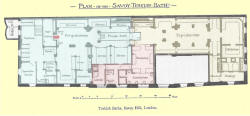
But the Turkish bath is also a facility—the area, or building in which bathers took their Turkish baths. Later on, such establishments also included showers, perhaps a steam room, and sometimes a cold plunge pool.
However, these were all additional to the Turkish bath process, and not part of it. The Victorian Turkish bath itself was not a process during which bathers came into contact with steam.
Yet writers frequently persist in referring to Victorian Turkish baths as vapour baths, or equating them to steam baths or hammams. The differences between the Victorian Turkish bath, on the one hand, and the hot-air baths found in Turkey and the Islamic world, on the other, are important.
For if a minor mythology of the bath is not to gain credence as a result of seeing things which were mostly not there, or did not appear till much later, we need to understand why the first Victorian baths were built, and how they were seen by their promoters.
It is, of course, confusing that the English-speaking world sees such baths as Turkish baths, and that until recently French-speakers saw them as bains turcs.
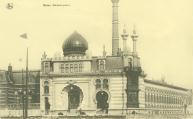
Les bains turcs, Dunkerque, France
More logically, perhaps, German-speakers, linking recent history with the more distant past, refer to them as Römisch-Irisches Bad (Roman-Irish baths).
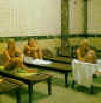
Baden-Baden
This isn’t a reference, as one writer has maintained,1 to the old Irish sweat bath—which is, incidentally, also to be found in American Indian cultures.
Tullynahaia, Co.Leitrim
The German name actually refers to the fact that the first Victorian Turkish bath was built in Co.Cork by the Irish physician, Dr Richard Barter, who, after some preliminary experiments, based it more closely on the ancient Roman bath.
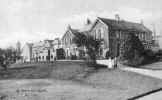
St Ann’s Hill, near Blarney
Barter owned a hydropathic establishment at St Ann’s Hill, near Blarney. He had earlier found that the sweat needed to remove, or at least alleviate, the pain of such complaints as gout and rheumatism, was more easily attained in a vapour bath than in the uncomfortable wet-sheet packing of the cold water cure practised by the followers of Vincent Priessnitz.
In 1856 Barter read The Pillars of Hercules2 in which David Urquhart described the hot-air baths he patronised when First Secretary at the British embassy in Constantinople. He later wrote:
On reading… [about the Turkish bath in] Mr Urquhart's The Pillars of Hercules, I was electrified; and resolved, if possible, to add that institution to my Establishment.3
The air in the hottest room was described as being dry, and Barter knew that the therapeutic effectiveness of hot air increased with its temperature, and that the body is able to withstand dry heat at greater temperatures than wet heat.
Barter contacted Urquhart, successfully inviting him to St Ann’s to help him build what Urquhart, and earlier travellers, had called a hammam, or ‘Turkish bath’.
Urquhart later admitted that he had originally written the chapters on the Turkish bath twenty years before The Pillars was published, and he had not originally realised how humid the air in the hammams had been.3
The Islamic adoption of hot-air baths from the eastern Roman empire, and their subsequent adaptation for ritual cleansing, led to the use of washing facilities within the hot rooms, inevitably giving rise to wet floors, humidity and general dampness.
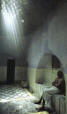
Hot room at
Al Salsila, Damascus, Syria
But, originally for medical reasons, the ideal Victorian Turkish bath was one in which any showers, washing facilities, or pools were located apart from the hot rooms so that the air within them was kept as comfortably dry as possible.
Yet so closely is our present vision of Turkish baths fixated on steam that one author claimed, after examining a handful of Irish establishments built between 1857 and 1863, that all Turkish baths in Ireland seemed to follow a similar plan.
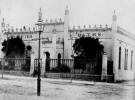
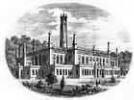
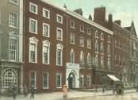
Limerick: Military Road
Bray: Quinsborough Rd
Dublin: Upper Sackville St
Three Turkish baths in the Ireland of the 1850s and ‘60s
This plan, it was suggested, featured ‘a central chimney disguised as a tower’, and that its purpose was to carry ‘excess steam away from the bathing chambers’. While inside the building, the guiding decorative principle was the use of ‘surfaces that could withstand the high levels of steam required in the treatment of patients.’4
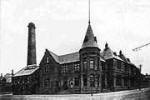
The Manchester Road Baths in Bradford were built in 1887. They had a large chimney even though it did not have a Turkish bath when it was built.
So it is necessary to insist that any such chimneys, like those adjacent to other buildings such as swimming pools and factories, were designed so as to allow smoke and combustion gases produced in the furnace to escape at a height sufficient to minimise fire risk and, in this instance, to keep fumes as far as possible from the low-level intake of fresh air which, after heating, will be inhaled by the bathers.