|
Victorian hydropathic
establishments mushroomed after the introduction into the British Isles of the cold water
cure made popular on the continent by the disciples of Vincent Preissnitz.1
The rigour of the
treatmentsthe wet sheet bath and the icy rain bath (shower)was an obvious
target for humorists. Contemporary caricaturists, such as Thomas Onwhyn, produced several
series of drawings depicting the tortures to which patients were subjected. These were
later reproduced as postcards, and since they were often posted by those 'tortured' to
their loved ones at home, hydros (such as Smedley's at Matlock Bank in Derbyshire) must
have taken their humour with good grace while profitably selling the cards in great numbers
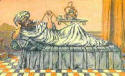
to their 'victims'. Not all illustrations poked fun at the bathers. Mr Punch's visit to a Turkish bath in 1861 was recorded in a relatively straightforward manner. And when, five years later, George Du Maurier drew At the Turkish bath, such establishments were already becoming popular and were to be found in an increasing number of towns and cities around the country. Du Maurier's point is made by linking here-now with there-later; to him, at least, the Turkish bath was no longer itself considered unusual or in any way ridiculous.
Originally published in May 1866, this caricature was still considered amusing enough to be included in a series of humorous postcards published by Evelyn Wrench some time between 1900 and (probably) 1902. The known difficulty of withstanding the excessively high temperatures to be found in some establishments was referenced, to good effect, in Tenniel's political cartoon, The Turkish bath. This appeared in 1876 shortly after Gladstone had published a pamphlet describing the atrocities committed by Ottoman forces in subduing the Bulgarian uprising. He attacked Disraeli's government for turning a blind eye to the massacres so as not to weaken Turkey's rôle as a counterweight to the growing influence of Russia. The pamphlet2 sold 40,000 copies in a week, and 200,000 by the end of the month.'3
By the middle of the twentieth century, when many more people had washing and bathing facilities in their own homes, the idea that some people could actually enjoy sweating in a hot room, be refreshed by a dip in a cold plunge pool, or feel more relaxed after a massage, was still, in some eyes, as funny as it was a century earlier—and perhaps, to the uninitiated, will remain so for ever. These drawings were made (at about the half way point between opening of the first Victorian Turkish bath and today) by the American illustrator George Luks.4 It is interesting to compare them with those of Thomas Onwhyn published 65 years earlier, for it is clear that Onwhyn is the more incisive. |