2. The reconstructed Turkish baths
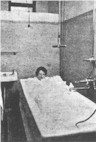
A Zotofoam bath
Even taking into account the intervening World War, the White Rock Baths remained closed for a very long time—nearly a quarter of a century—a period during which the condition of the baths steadily deteriorated until a complete rebuild was necessary. But having finally decided that the baths were to be re-opened, they were built to incorporate all the latest facilities, such as Zotofoam baths, which were not available when the baths were first built.
Writing in 1935, Mr H Baker, Superintendent of the reconstructed and newly re-opened facility, said that it was 'probably the only building of its size and type which is entirely underground'.9 There was roughly an acre of floor space which was 30ft below the ground, and the lowest section of the boiler house was 'approximately 14ft below the high water spring tides.' In such a situation, it seems—with the benefit of hindsight—that some of the problems which caused structural faults in the original baths would inevitably cause similar problems again. Indeed, when the new baths closed after thirty-three years in 1968, structural problems were stated to be the reason.
The reconstruction, like the initial build, was completed in several stages, the second of which saw the completion of the Turkish, slipper, and medicated baths. In describing the new suite of Turkish baths, Baker made a point of remarking that 'advantage was taken of the site to design the sequence of treatments in a suite of rooms forming an unbroken straight line from the boot room at the entrance to the laconicum.' It may be that this suggests that the original sequence of hot rooms loosely followed what could be called the 'golden section style'.
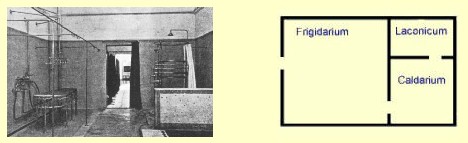
The major difference between old and new was in the types of fuel used. The original boiler burned coke, and latterly anthracite, necessitating—as described earlier—the construction of a tunnel and chimney to extract the smoke and fumes.
The coke fumes may well have been successfully removed from the immediate vicinity of the baths but, as the years passed by, there was an increasing number of complaints from those who lived near the chimney. Today, over 120 years later, the remains of the chimney can still be seen.
In the new baths, although the swimming pools were heated by steam, generated by oil-fired boilers, the Turkish bath was heated by a gas stove. No oil-fired stove could be found which was considered suitable for a Turkish bath, and steam—which had been used the previous year in the Birmingham Kent Street Turkish baths—had not been found satisfactory.
While the gas used for the Turkish baths cost three times as much as the coke, the bill for heating the swimming pools using oil was a third less than before, with the added advantage that there were no more complaints about the fumes from the old chimney.
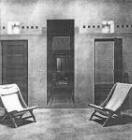
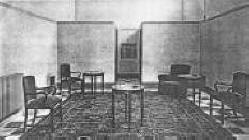
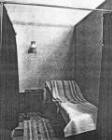
The new Turkish bath comprised three hot rooms, a shampooing room with Vichy and needle douches, and a cooling-room with cubicles in which the bather could change and later relax. In addition there were two steam rooms and a sea-water plunge pool.
Throughout the Turkish baths, the floors, walls (to a height of 7ft), and plunge pool were finished in attractive terrazzo mosaic designs, while a carpet graced the floor of the cooling-room.
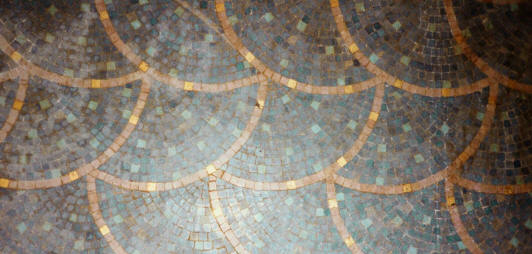
< Photo: Shifrin
As in the original Turkish baths suite there were separate times for women, though one would never guess this from the celebratory booklet published by the Council shortly after the baths opened.
Every room in these wonderful Turkish Baths is restful. Slumped in his deck-chair in the steam rooms or lying on his couch in the cooling-off cubicle, the bather feels that this is really doing him good. Through the various hot, steam, cold and shampoo rooms he goes until he reaches the sea-water plunge—the perfect end to a perfect Turkish Bath. Then—what a deep, glorious sousing. He steps out—the tired business man has disappeared.10
But the Council was proud of its new baths claiming, with some justification, that they were 'amongst the very finest in England'.