'Semi-success' in London:
David Urquhart, the London Hammam, and
the London & Provincial Turkish Bath Co Ltd
This is a single frame, printer-friendly page taken from Malcolm Shifrin's website
Victorian Turkish Baths: their origin, development, and gradual decline
Visit the original page to see it in its context and with any included images or notes

5. Urquhart's rôle and remuneration
In accordance with the company’s articles, Urquhart was wholly involved in setting up the baths, approving a site, and working with the notional architect, George Somers Clarke who was, according to the company minutes, ‘willing to superintend as architect the erection of the Baths and that he would do so under Mr Urquhart's supervision.'
Initially, Urquhart would also be responsible for appointing staff and generally supervising the day to day running of The Hammam. Yet he refused any remuneration, treating the £1,000 he had put into the company as a ‘loan’. Problems relating to his rôle in the company and his remuneration were not easily resolved.
The company knew it would not easily survive without him and could not afford—indeed did not wish—to offend him, yet his personal beliefs militated against any normal financial arrangement.
After much discussion and correspondence, some with Harriet, who played—as not infrequently before and afterwards—the rôle of intercessor, Urquhart had contented himself with stating,
that he had carefully considered the matter of compensation to himself, that he had felt extreme satisfaction at the proposal of the directors but he had conclusively determined not to accept any remuneration for his services to the company but that he would not decline an indemnification of his actual expenditure in the matter.
Yet less than two weeks later Urquhart changed his mind again and in a long letter to Stewart Rolland, the ‘Chairman of the Bath Company’, said that he had written to the Company Secretary resigning his Honorary Directorship. He had also decided to withdraw his refusal to receive ‘compensation on the part of the company’ and that he would,
apply that compensation to that object wh[ich] I have had from the beginning in mind namely the establishment of Baths for the Working Classes free from any charge…
He said that he had found it repugnant to be connected with a joint stock company and knew there would be constant disagreements on charges.
The Company will be looking to its profits. I shall be looking to charges lowered for the Working Classes.
Those perhaps surprised at the friendly relationship between the patrician Urquhart and the revolutionary Karl Marx may not have realised that they agreed on far more than their common hatred of Russia.
Rolland acted quickly to nip the latest problem in the bud fearing its effect on possible investors. He smartly put the issue on hold and immediately attempted to divert Urquhart's thoughts towards the exciting potentialities presented by the finding, after a long search, of suitable premises at 76 Jermyn Street.
A month later Rolland sorted the matter out with Harriet and it was agreed that Urquhart would accept 200 shares in return for his ‘loan’ to the company.
This page revised and reformatted 02 January 2023
The original page includes one or more
enlargeable thumbnail images.
Any enlarged images, listed and linked below, can also be printed.
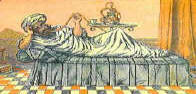
Betowelled patron of the London Hammam
Plan and cross-section of the London Hammam


Victorian Turkish Baths: their origin, development, and gradual decline


Comments and queries are most welcome and can be sent to:
malcolm@victorianturkishbath.org
The right of Malcolm Shifrin to be identified as the author of this work
has been asserted by him
in accordance with the Copyright, Designs and Patents Act 1988
© Malcolm Shifrin, 1991-2023