Towards a history
of the Victorian Turkish bath:
a preliminary review
of some of the available sources
This is a single frame, printer-friendly page taken from Malcolm Shifrin's website
Victorian Turkish Baths: their origin, development, and gradual decline
Visit the original page to see it in its context and with any included images or notes

4. Some early publications
The re-introduction of the Turkish bath was not instantly accepted as being 'a good thing'. Even the process of bathing in warm or hot water was not, in general, easy to accomplish in most of mid-nineteenth century Britain. It is therefore unsurprising that, for a large proportion of the population, the concepts of bathing or of personal hygiene could seem strange or, at best, impossible to achieve with any degree of frequency.
Those propounding the virtues of the bath did so, in the main, by publishing pamphlets, writing letters to local newspapers, and holding public meetings to gather support.
Pamphlets
Probably the first publication wholly devoted to the Victorian Turkish bath was Barter’s reprint, as a pamphlet, of the two chapters on the bath from The Pillars of Hercules. Thereafter, the Urquhart-inspired publicity machine got under weigh with a veritable stream of articles in newspapers and medical journals, to be followed by a number of expository books aimed at the general reader who was (by implication) the potential bather.
While many of the pamphlets were written simply to explain the value of the Turkish bath as an aid to hygiene, to describe the procedures to be followed during a visit to the bath, or to catalogue the diseases and illnesses which the bath so often claimed to cure, most were designed to advertise specific establishments. Some, as for example, Potter’s The Roman or Turkish bath merely placed a discreet announcement near the beginning or end of the booklet; others were more openly designed to argue the superiority of a particular establishment, or establishments.
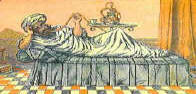
But few were as copiously illustrated as one of Bartholomew’s guides. This was intended to emphasise his use of a standard decor and identical furnishings in each of his Turkish baths, particularly his use of painted glass screens. Potential bathers were thus able to recognise a Bartholomew establishment as soon as they crossed the threshold. Charles Bartholomew, always adept at publicity, seems to have created his 'brand' of Turkish bath several years before the adoption of company logos and house styles became the norm (for as yet unborn) multiples and chain stores.
Other pamphlets dealt with specific issues, such as John Laws Milton’s On the modified Turkish and vapour bath and its value in certain diseases of the skin. And the pseudonymous A J’s advocacy of the bath as ‘antidote for the cravings of the drunkard’ was but one of many publications in which temperance workers propounded the value of the Turkish bath as an effective weapon in the fight against alcoholism.
Books
Some much-quoted works can be disappointing when the original is found. A case in point (reviewed with reservations even on publication) is Manual of the Turkish bath, edited from the writings of Urquhart by Sir John Fife. Although there is much of interest which is unavailable elsewhere (like the Socratic dialogues which purport to have taken place at Urquhart’s celebrated Riverside baths), the form of the book—almost a scrapbook—is unsatisfactory. Better are Erasmus Wilson’s excellent, if over-flowery, The Eastern, or Turkish bath, Balbirnie’s The Sweating cure, and works by Coley and Drake.
Five books are of outstanding interest to the historian of the Turkish bath. Each is by an individualist whose contribution to the subject is unique.
Metcalfe’s The rise and progress of hydropathy in England and Scotland (broader in scope than its title suggests) and Sanitas sanitatum et omnia sanitas have already been mentioned. Constantine’s Fifty years of the water cure, with autobiographical notes (also wide-ranging) is especially good on the problems of heating the bath.
Durham Dunlop’s comprehensive and often amusing The Philosophy of the bath, or air and water in health and disease is dedicated to Dr Richard Barter. As the inclusion of the word philosophy in the title indicates, Dunlop's book is not merely a description of the bath; it also looks at more theoretical aspects of its use. While giving Urquhart due credit for bringing the bath to everyone's attention, it strongly emphasises Barter's rôle in its reintroduction and tells of the antagonism of much of the medical profession to the bath at that time. Dunlop was not over-enamoured of the contemporary medical profession and some of what he had to say about it is, perhaps, still valid.
Finally, in this group, is The Turkish bath by Robert Owen Allsop. Though it is now over one hundred years old, it was a first class comprehensive guide to the construction of Turkish baths written for contemporary architects and builders. It remained the most recent work on Victorian Turkish baths, until my own was published in 2015.
In the nature of things, most of the contemporary works dealing with the effects of the Turkish bath on the human body are inaccurate or, at best, seriously out of date. Because the Turkish bath is now in terminal decline, very little new medical research is undertaken. Yet while the type of heat provided in the sauna is different from that of the Turkish bath, many of its effects on the body will be broadly similar. So it is most welcome that in 1988 a special edition of Annals of clinical research, published (in English) in Helsinki was devoted wholly to the sauna. In addition to sixteen papers on the physiological effects of the sauna on the human body, there are others on psychoanalytical aspects, sport, children, and alcohol. All will be of value in any modern study of medical aspects of the Turkish bath.
Lectures and public meetings
Lecturing was also undertaken as a means of spreading the word. Addressing public meetings, speakers like Urquhart in Cork (on cleanliness) and Dr Barter in Dublin (on his improved Turkish bath) sought to raise general public awareness. Other practitioners—Le Gay Brereton in Sheffield (on the therapeutic advantages of the bath), Beamish in Gloucestershire (on the skin), Erasmus Wilson to the Annual Meeting of the British Medical Association in Torquay (on Thermo-therapeia, the heat-cure) and Spencer Wells (to students at the Grosvenor Place School of Medicine)—all attempted to educate (or convert) their medical colleagues to the therapeutic uses of the Turkish bath. Le Gay Brereton went further afield in his proselytising work, moving to Australia and building, after some correspondence with Urquhart on the practicalities, the country's first Turkish bath in Spring Street, Sydney.
Reading such lectures it is impossible not to become aware of their inordinate length and their repetitiveness. Nevertheless they provide a revealing view of doctors' perceptions of the health concerns of their patients in the third quarter of the nineteenth century, and contribute to a better understanding of how they saw the general state of people’s health at this time.
Proprietors often called public meetings to drum up support for the opening of a new establishment. Bartholomew did this in 1863 at Neath and, less successfully, five years later in Oxford.
With more of the public interest in mind, Barter travelled all the way to lecture at the Bradford Mechanics’ Institute and in response to a request from James Smithies (the Rochdale Pioneer who had just been appointed Chairman of the Rochdale fac) Urquhart visited the Polytechnic Institution and gave a lecture which soon led to the opening, on 14 November 1859, of the first co-operatively owned Turkish bath.
This page revised and reformatted 02 January 2023
The original page includes one or more
enlargeable thumbnail images.
Any enlarged images, listed and linked below, can also be printed.
William Potter's second Turkish Baths, Manchester
Cooling-room at Bartholomew's Birmingham baths
Cooling-room at Bartholomew's Turkish Baths in the City of Bath
Design for a private Turkish bath by Robert Owen Allsop
Back page advertisement for two pamphlets by Bartholomew


Victorian Turkish Baths: their origin, development, and gradual decline



Comments and queries are most welcome and can be sent to:
malcolm@victorianturkishbath.org
The right of Malcolm Shifrin to be identified as the author of this work
has been asserted by him
in accordance with the Copyright, Designs and Patents Act 1988
© Malcolm Shifrin, 1991-2023