The hot room in the private Turkish bath at Cragside, Rothbury
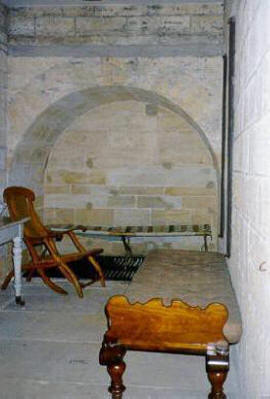
< Photo: Shifrin
In addition to the hot room at Cragside, Lord Armstrong's private Turkish bath suite had a cooling/dressing room, and a plunge pool with shower. The suite was almost certainly used by the Prince of Wales (a frequent patron of the Jermyn Street Hammam) on his visits to Cragside.
The house was originally built for Lord Armstrong to the design of an unknown architect early in the 1860s. It was much enlarged and reconstructed by Norman Shaw at the end of the decade. Shaw's plans for a Turkish bath suite under the library are dated 5 May 1870, but they were considerably altered before they were built. They were ready for use on 4 November. 1
Norman Shaw is not known to have previously built a Turkish bath, and it may well be that he took advice from the Tyneside architect, James Shotton.
Some time earlier, Shotton had built a private Turkish bath for George Crawshay (who falsely claimed that it was the first to be built in England since Roman times)2 and also, in 1869, the Cecil Street Turkish baths in North Shields. Five years later, in 1874, Shotton went on to design the Pilgrim Street Turkish Baths for the Newcastle-upon-Tyne Turkish Bath Company Limited. The company secretary was John H Armstrong, its chairman was Addison Potter, and its shareholders included two Watsons, one of whom was a Director—all of whom were related to Lord Armstrong.
Cragside is now owned by the National Trust, is open to the public, and well worth a visit. My personal views on the building of the Turkish bath at Cragside do not necessarily agree with those of the trust. Further information will appear, in due course, in the directory section of the website.
This page enlarges an image or adds to the information found below:
Heritaging the Victorian Turkish bath: creating a saleable asset
List of articles on the history of the Victorian Turkish bath included in the site

Victorian Turkish Baths: their origin, development, and gradual decline



Comments and queries are most welcome and can be sent to:
malcolm@victorianturkishbath.org
The right of Malcolm Shifrin to be identified as the author of this work
has been asserted by him
in accordance with the Copyright, Designs and Patents Act 1988
© Malcolm Shifrin, 1991-2023