This is a single frame, printer-friendly page taken from Malcolm Shifrin's website
Victorian Turkish Baths: their origin, development, and gradual decline
Visit the original page to see it in its context and with any included images or notes

2. Urquhart and Barter
We now look at the naming of the new bath ; at attempts made to enhance its credibility and make it a more saleable asset. How, in other words, the Victorian Turkish bath was heritaged.
Two men were responsible for its introduction into the British Isles.
The first was Scottish-born diplomat and politician David Urquhart who came across the Islamic hammam during his years at the British embassy in Constantinople in the 1830s.
Twenty years later he wrote about it in a quirky travel book, The Pillars of Hercules, in which he described hammams in the Maghreb. But he first described what he called the Turkish bath because it was in Turkey that he found the bath used in its most complete form, and because the term was already familiar to readers of travel books, archaeological works, and diaries.
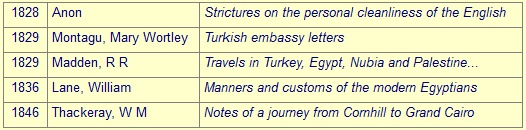
The first work here is different from the others (which merely describe the bath); its anonymous author argued, twenty-five years before Urquhart, and also to no avail, that the government should build Turkish baths and provide them at a nominal cost to those who could not afford them.
Because of works such as these, the term Turkish bath was already established when referring to the Islamic hammam. Of course, Urquhart well knew the history of the bath and its Roman antecedents, but he had a political agenda: promoting Turkish culture in Britain to encourage the government to pursue a more pro-Turkish, anti-Russian foreign policy.
Urquhart had set up a number of working-men’s Foreign Affairs Committees whose members, after rigorous but effective training, called political meetings, wrote to newspapers, and petitioned their members of Parliament. They also wrote to each other about Turkish baths, often in the same letters as their political communications.
His pro-Turkish views, together with his Turkish bath campaign, were also promulgated in Isaac Ironside’s sympathetic paper, The Sheffield Free Press, and later in its successor, The Free Press, which was sold around the country by members of the various committees. The latter was financed by George Crawshay, later to become a director of the London and Provincial Turkish Bath Company Ltd.
Urquhart also encouraged committeemen to self-build commercial Turkish baths to help support their families, giving them more time for political work, and premises where meetings could be held. At least 35 such baths are known.
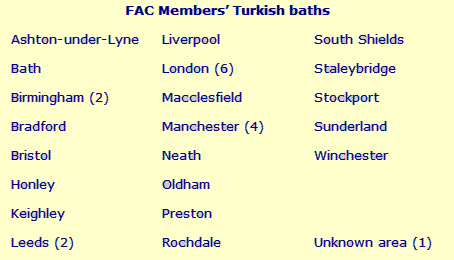
By any standard, the committees’ achievement was remarkable. Some establishments, like John Shaw’s, one of the first six Turkish baths in England, opened at St Peter’s Square, Leeds, in 1858, and remained open for nearly fifty years.
The second person responsible for the introduction of the Victorian Turkish bath was an Irish Physician, Dr Richard Barter, who owned one of the first two hydropathic establishments in Ireland, at St Ann’s Hill, Blarney, in County Cork. He was an open-minded hydropathist who, earlier, had aroused the ire of his peers by adding vapour bath cabinets to the strictly orthodox cold water cure originally prescribed by Vincent Priessnitz.
In 1856 Barter came across The Pillars of Hercules, noting that Urquhart described the air in the hottest room of the Turkish bath as being ‘dry’. Knowing that the therapeutic effectiveness of hot air increases with its temperature, and that the body is able to withstand dry heat at greater temperatures than wet heat, he invited Urquhart to St Ann’s to help him build a Turkish bath for his patients.
Experimental baths were first constructed, and success was by no means immediate. Advice was sought from the Ottoman Sultan. And Barter sent his architect namesake—Mr Richard Barter—to study the bath ruins in Rome. For he realised that the surviving hot air baths of the Eastern Roman Empire had changed after the fall of Constantinople.
Their adoption by Islam, and their adaption for ritual cleansing prior to prayers, led to the use of washing facilities within the hot rooms, inevitably giving rise to wet floors, humidity, general dampness, and consequently, lower temperatures. Even Urquhart later admitted that initially he had not fully realised the significance of this dampness in the hammam, and all his baths, like Barter’s, kept the hot rooms dry.
Leaving Ireland, Urquhart immediately set about helping his Manchester Foreign Affairs Committee to build the first Turkish bath in England since Roman times. First display advertisement.
This page revised and reformatted 02 January 2023
The original page includes one or more
enlargeable thumbnail images.
Any enlarged images, listed and linked below, can also be printed.
Al Salsila Hammam in Damascus
David Urquhart, soon after his marriage in 1854
John Shaw's Turkish bath at St Peter's Square, Leeds, 1890s
Letter about a new bath in Stockport
St Ann's Hydropathic Establishment, c.1880
Strictures on the personal cleanliness of the English
The Turkish bath in The Free Press
Title page of The Pillars of Hercules


Victorian Turkish Baths: their origin, development, and gradual decline



Comments and queries are most welcome and can be sent to:
malcolm@victorianturkishbath.org
The right of Malcolm Shifrin to be identified as the author of this work
has been asserted by him
in accordance with the Copyright, Designs and Patents Act 1988
© Malcolm Shifrin, 1991-2023