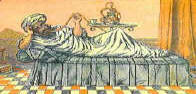
Portable Turkish bath, with shower incorporated
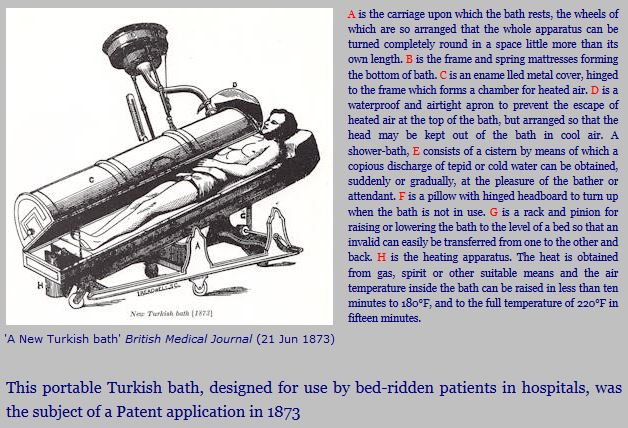


This portable Turkish bath, designed for use

by bed-ridden patients in hospitals,

was the subject of a Patent application in 1873


Portable Turkish bath for hospital patients


A is the carriage upon which the bath rests, the wheels of which are so arranged that the whole apparatus can be turned completely round in a space little more than its own length. B is the frame and spring mattresses forming the bottom of bath. C is an enamelled metal cover, hinged to the frame which forms a chamber for heated air. D is a waterproof and airtight apron to prevent the escape of heated air at the top of the bath, but arranged so that the head may be kept out of the bath in cool air. A shower-bath, E consists of a cistern by means of which a copious discharge of tepid or cold water can be obtained, suddenly or gradually, at the pleasure of the bather or attendant. F is a pillow with hinged headboard to turn up when the bath is not in use. G is a rack and pinion for raising or lowering the bath to the level of a bed so that an invalid can easily be transferred from one to the other and back. H is the heating apparatus. The heat is obtained from gas, spirit or other suitable means and the air temperature inside the bath can be raised in less than ten minutes to 180°F, and to the full temperature of 220°F in fifteen minutes.

< 'A New Turkish bath'      British medical journal      (21 Jun 1873)


This page enlarges an image or adds to the information found on the following page:

Cabinet and lamp baths
          

This is a page from

Victorian Turkish Baths:

their origin, development,

and gradual decline

 Comments and queries

are most welcome.

To return to your previous page

USE THE BACK ARROW

Otherwise, use one of these:

Home Page

No frames version

The right of Malcolm Shifrin to be identified as the author of this work has been asserted by him
in accordance with the Copyright, Designs and Patents Act 1988