This is a single frame, printer-friendly page taken from Malcolm Shifrin's website
Victorian Turkish Baths: their origin, development, and gradual decline
Visit the original page to see it in its context and with any included images or notes


Savoy Turkish Baths Limited
Company baths:
LONDON: 9 Caledonian Road
LONDON: Railway Approach
Jermyn Street Turkish Bath Company Limited
Companies House files destroyed
The history of this company, one of two pre-eminent chains of Turkish baths located in London, is clouded in uncertainty. No records of the company have so far come to light and those at Companies House were destroyed before records were transferred to the (then) Public Record Office at Kew.
Most of the London Turkish baths dates which form the chronologies in the Directory section of this site are based on those taken from Kelly's London Directories and must be considered approximate. The gap between the first occurrence of the Savoy (relating to the ownership of the Brixton Road baths in 1911) and the first dates given for the ownership of the remaining establishments in the chain (1917) is more likely to be due to tardy updating of the directories, than actuality.
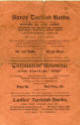
Coronation
procession
ticket
Only two things are known with certainty about Savoy Turkish Baths Limited. First, that nine baths in London were at one time or another owned by the company; second, that the Jermyn Street Turkish Bath Company Limited was set up in 1946, specifically to acquire the Savoy, which object it duly accomplished, either later that year or early in the following year.
All nine of the London baths were owned by William Cooper before becoming part of the company. One of the baths, that at 120 Kensington High Street, seems to have been started by Cooper himself around 1911. The remaining eight were bought as going concerns, either in groups or individually.
Cooper seems to have acquired his first Turkish bath, the one in Brixton Road, in 1909 from Henry William Rance. Two other baths, Savoy Hill and Railway Approach, were bought from Rance, presumably at the same time. The Savoy Hill baths were probably the most lavishly equipped, being purpose-built and designed by C J Phipps, architect of the Savoy Hotel next door. The association of the name Savoy with a quality hotel made it an obvious name for the new company which was to own the new chain.
So although the remaining baths purchased between 1910 and 1912 were listed under the ownership of William Cooper, it seems likely that the Savoy company was started some time late in 1910 or early in 1911, when it was first mentioned in Kelly's.
It was certainly in existence in 1913 when there was a Shops Act prosecution against the company over its use of the description 'Droitwich Brine Baths' for their own brine baths. The court ruled against them that Droitwich Brine Baths could only be obtained at Droitwich.
It seems that Cooper sold his baths to a newly formed public company in order to finance the purchase of additional Turkish baths, and he is known to have remained Managing Director until at least 1931.
In any event, the chain was rapidly expanded by the purchase of three further Turkish baths from Ernest Henry Adams. These were the baths at Caledonian Road, Jermyn Street and Duke of York Street. The last two were situated round the corner from each other and it may be that the last-named was already a Turkish bath for women only—it had certainly become one by 1917.
The last two (contrasting) baths were those at Newington Causeway and Camden Town, the latter also being a purpose-built establishment designed by the well-known architect H H Bridgman.
Few of these Turkish baths were still in operation by the time the Savoy company was sold just after the end of the second world war. The Camden Town bath burnt down on 30 March 1916.
Turkish baths became less popular between the wars as more homes included baths and bathrooms. The establishments in Kensington High Street, Railway Approach, Caledonian Road, and even the Savoy Hill flagship, were all closed between 1920 and 1921. Brixton Lane does not seem to have survived after that, and Newington Causeway was destroyed in the blitz in 1941.
This page last updated 30 January 2022
The original page includes one or more
enlargable thumbnail images.
Any enlarged image, listed and linked below, can also be printed.
Coronation procession ticket


Victorian Turkish Baths: their origin, development, and gradual decline



Comments and queries are most welcome and can be sent to:
malcolm@victorianturkishbath.org
The right of Malcolm Shifrin to be identified as the author of this work
has been asserted by him
in accordance with the Copyright, Designs and Patents Act 1988
© Malcolm Shifrin, 1991-2023