Ben Rhydding Hydropathic Establishment:
the Turkish baths,
c.1859: the frigidarium
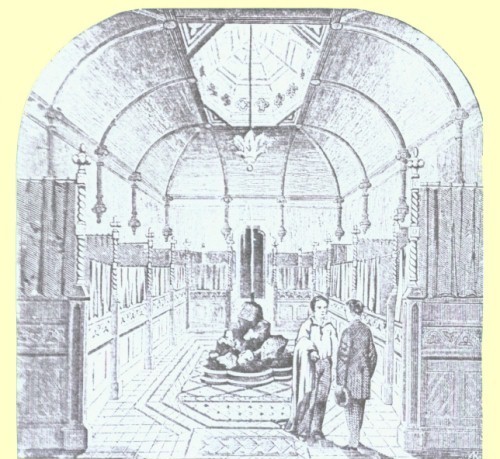
As soon as bathers entered the frigidarium, or cooling-room, their clothes were exchanged for a bathing dress (for women) or a sheet (for men), together with a pair of wooden pattens which protected the feet from the heat of the floor.
The frigidarium was 36 feet by 32 foot six inches in area and 30 feet high. Light from an opening at the top was filtered through stained glass to give a soft and pleasing appearance. Ranged round the room, from a passage behind, were dressing rooms with couches enabling people to prepare for, and relax after, the Turkish bath. The central part of the floor was of patterned encaustic tiles in colour, with a decorative fountain as centrepiece. Around the walls, curved ribs—partly masked by carved corbels—supported the coved and vaulted ceiling.
This page enlarges an image or adds to the information found below:
Ben Rhydding Hydropathic Establishment

Victorian Turkish Baths: their origin, development, and gradual decline



Comments and queries are most welcome and can be sent to:
malcolm@victorianturkishbath.org
The right of Malcolm Shifrin to be identified as the author of this work
has been asserted by him
in accordance with the Copyright, Designs and Patents Act 1988
© Malcolm Shifrin, 1991-2023