'Semi-success' in London:
David Urquhart, the London Hammam, and
the London & Provincial Turkish Bath Co Ltd
This is a single frame, printer-friendly page taken from Malcolm Shifrin's website
Victorian Turkish Baths: their origin, development, and gradual decline
Visit the original page to see it in its context and with any included images or notes

2: A couple of books and a couple of Acts
As a lifelong sufferer from neuralgia, Urquhart’s own primary concern was the therapeutic properties of the Turkish bath. But, unlike Richard Barter, this was not his main emphasis in promoting its public use.
First and foremost, he campaigned to promote the widespread building of Turkish baths as the most effective means of promoting personal hygiene and cleanliness, ‘for the cleansing of the mind and body go hand in hand’.
Second, he believed that Turkish baths should be cheap enough to be accessible to the poorest members of society.
Third, and perhaps surprisingly, he believed that Turkish baths could break down class barriers by providing a place where people of all classes could easily mix.
Urquhart was not the first to espouse Turkish baths. Strictures on the personal cleanliness of the English, with a description of the hammams of the Turks was privately published by its anonymous author in 1828, twenty-two years before Urquhart’s The Pillars of Hercules brought the bath to a much wider public in 1850.
Yet the harder-hitting, better-argued Strictures made no impact. Richard Beamish, in an 1859 lecture, suggested that,
It is true that an anonymous author had, in 1828, anticipated with equal force and not less erudition, all that Mr Urquhart had advanced in 1850, but he was not so fortunate as to find a Dr Barter to give practical effect to his suggestions.
It seems more likely that Strictures was just a few years too early, appearing before the cholera epidemics of 1831, 1848, and 1853 and before enabling acts of 1846 and 1847 encouraged the establishment of public baths and wash-houses. By this time cleanliness had become an issue of general concern.
But if Strictures was a few years too early, Urquhart was a few years too late. When the legislation was enacted there was no mention of Turkish baths because they did not yet exist. Consequently, solicitors in many local authorities advised that they could not legally be included in bath houses built at public expense. Vapour baths, however, had existed prior to the Acts, and were therefore permitted.
The 1846 act legislated that there should be at least two classes of baths, that there should be not less than twice as many baths for the labouring classes as for all other classes together, and that no warm bath, shower bath, or vapour bath intended for the labouring classes could cost more than twopence.
Had Urquhart written about the Turkish bath on his return from Constantinople in 1837, or had he campaigned while the acts were being considered, then his dream of Turkish baths for the masses might have stood at least some chance of success.
Instead, for many years afterwards, claims that the Turkish bath was more economical than warm water baths and more effective as a cleansing agent, usually fell on deaf ears.
This page revised and reformatted 02 January 2023
The original page includes one or more
enlargeable thumbnail images.
Any enlarged images, listed and linked below, can also be printed.
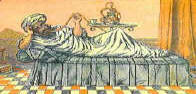
Betowelled patron of the London Hammam
Title page of Strictures on the personal cleanliness of the English
The Pillars of Hercules: title page
Cottage Baths Lower Dartmouth Street, Birmingham, c.1910


Victorian Turkish Baths: their origin, development, and gradual decline



Comments and queries are most welcome and can be sent to:
malcolm@victorianturkishbath.org
The right of Malcolm Shifrin to be identified as the author of this work
has been asserted by him
in accordance with the Copyright, Designs and Patents Act 1988
© Malcolm Shifrin, 1991-2023