Roman? Turkish? Middle class?
'Classical porticos' and 'touches of eastern splendour':
the appearance of the Victorian Turkish bath
This is a single frame, printer-friendly page taken from Malcolm Shifrin's website
Victorian Turkish Baths: their origin, development, and gradual decline
Visit the original page to see it in its context and with any included images or notes

4. A working class movement
But looking at these two examples, it is important to realise that though there was an undoubted spate of new Turkish baths being opened in the 1860s, only a minority were purpose-built. And while, in the 140-plus years since the first bath opened, there have been a number of ‘set piece’ establishments, the overwhelming majority were in converted houses and shops.
I have so far identified over 600 Turkish baths opened during this period. Only 138 (or about 23%) were purpose-built, 79 by local authorities (usually as part of a swimming bath complex) and 49 by small companies.
Of these 138 purpose-built baths only one was built in Roman style, and only 10 (or just possibly 12) had an exterior, designed to any significant extent, in a Turkish style.
It is, perhaps, understandable that it’s the set piece establishments which are written about, and about which theories of design and orientalism are woven—it is, of course, easier to find information about them.
But if we ignore the small Turkish baths set up by members of David Urquhart’s foreign affairs committees, for example, we get a completely distorted view of the origins of the bath, because the working class promotion of the bath as a cleanser and healer disappears from view.
The foreign affairs committees, of which there were over 100 at one time, promulgated Urquhart’s political views by holding meetings and writing to members of parliament. They also formed the nucleus of what was, in effect, a Turkish Bath Movement. Members corresponded with each other, and with Urquhart, about the bath, and disseminated news about them in his political paper, the Free Press.
Urquhart encouraged them to build Turkish baths to help support their families, thereby also giving them more time for political work, as well as premises where meetings could be held.
In 1857, on Urquhart’s return from Blarney, the Manchester Foreign Affairs Committee built the first Turkish bath in England to open for public use since Roman times.
It was managed, and then owned, by William Potter. Potter’s success fed the committee grapevine and, eighteen months later, at the end of 1859, there were nine Turkish baths in England so far identified as being owned by Foreign Affairs Committees or their members.
The first Turkish bath in London was opened in Bell Street, off the Edgware Road, the following year by Roger Evans, another committee man.
Dr R H Goolden wrote to The Lancet about a visit he made:
For some time I watched the effect of the bath in Bell-street, before the establishment of many edifices, so much more complete, which have since been established; and I went into the bath at such times as that I could observe its effects upon the lower classes, who resorted there in great numbers, not as a luxury, but as a remedy, as they supposed, for disease; and I consider, however much anyone may sneer at my occupation, I could not be better engaged than amongst these people, and studying so interesting a subject, even at some inconvenience. There were often ten people in the hot room at one time, all invalids, and I found them quite willing to tell me all their complaints, and to let me examine them. They were principally artizans, small shop-keepers, policemen, admitted at a small fee. I saw there cases of fever, scarlatina, phthisis, gout, rheumatism (acute and chronic), sciatica and tic douloureux, periosteal nodes, bronchitis, pleurisy; forms of skin disease—viz, eczema, psoriasis, lepra, impetigo; diseased liver, dyspepsia, ague, dropsy, with diseased heart and diseased kidneys.
To expect a cure, or even benefit, in all these cases, would be unreasonable; but I found relief produced to a far greater extent than I was prepared for. The most marked relief was found in cases of gout, rheumatism, periosteal nodes, and sciatica...
By any standards, the achievement of the committees was remarkable. At least 35 Turkish baths were built by their members for public use.
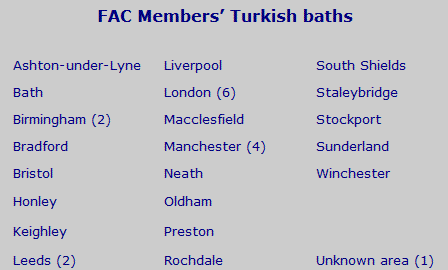
Some, like John Shaw’s establishment in Leeds (above) remained open for nearly fifty years. Often they were small. Henry Butcher wrote to Urquhart in 1866 about his new bath in Winchester:
Having opened this Bath for a fortnight free to anyone who we could induce to avail themselves of the opportunity, have much pleasure to inform you that about 40 persons have passed through highly pleased and delighted with the result.—the cost of this with the addition of the Dressing Room to our house, amounting to little over twenty pounds—We have great expectations of making it in a pecuniary point of view a profitable undertaking—for am glad to state we have already taken £1-2-6 thus far—to realise the hope Mr Urquhart held out to us when at Winchester that it may be made a profitable investment, besides being a blessing to ourselves and neighbourhood.
Not for nothing did George Jacob Holyoake tell the readers of The Reasoner that ‘Mr Urquhart is entitled to the thanks of the working class for putting this power into their hands, or at their service.’
Barter went on to open several establishments around Ireland, including Turkish baths for the poor in Cork and Belfast, at a time when, in one Irish city, for example, according to a letter in The Lancet,
Fever and small-pox are rife; the city is badly drained; the back streets and lanes are in a filthy, unhealthy state, and there is scarcely any sewerage. The working class live and die in wretched cellars and garrets, in dirt and poverty.
While there was no working class Turkish bath movement in Ireland, the major initial justifications for the bath were still therapeutic and hygienic.
Yet the author of a recent paper appears to suggest that the Victorian Turkish bath was introduced in Ireland to meet the middle class demand ‘for services catering to tourists.’
It seems to me that there is little evidence to support such a view. There does seem on occasion, however, to be a tendency to start with the present, and look back for evidence with which to support a preconceived view of how we got here.
This page reformatted 02 January 2023
The original page includes one or more
enlargeable thumbnail images.
Any enlarged images, listed and linked below, can also be printed.
Dalston Junction Turkish Baths, London
Cooling room at the London Hammam
Nevill's New Broad Street entrance
St Peter's Square, Leeds, 1890s
Joseph Foden's letter to John Johnson, 1860
Display ad for the first Victorian Turkish bath in England

Victorian Turkish Baths: their origin, development, and gradual decline



Comments and queries are most welcome and can be sent to:
malcolm@victorianturkishbath.org
The right of Malcolm Shifrin to be identified as the author of this work
has been asserted by him
in accordance with the Copyright, Designs and Patents Act 1988
© Malcolm Shifrin, 1991-2023