This is a single frame, printer-friendly page taken from Malcolm Shifrin's website
Victorian Turkish Baths: their origin, development, and gradual decline
Visit the original page to see it in its context and with any included images or notes

5. The Shampooers' wages
Although Urquhart and his supporters argued that Turkish baths were most needed in areas of poverty, they soon tended to become established in the better off areas. In considering the shampooers' wages it must be remembered that the three establishments visited by Booth's interviewers were all in the West End of London. Mr Nevill's view was that,
‘Turkish bathing is a rich man’s luxury & not a poor man’s necessity.’ No man takes a turkish bath unless he is earning £200 per year: naturally there are some exceptions, sick working men, etc.
So before considering the shampooers' wages at that time, it is worth taking note of the cost of a Turkish bath at each of the three establishments visited, and at two others for purposes of comparison.
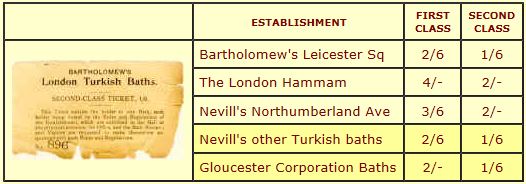
In each of these establishments, the second class baths were the same as the first class baths but the cheaper rate was limited to special times, usually in the evening. A few baths actually had separate Second Class facilities of a lower standard, but none of these was surveyed by Booth.
In London, according to Nevill, the
Standard wage of a shampooer is 20/- [per week]
yet this is the lowest amount paid at any of the three establishments surveyed. At Nevill's,
They pay 22/- simply to be able to say that ‘Nevills pays more than anyone else.’
The moneytaker at each bath. He is the Superintendent & the whole place is under his control. He is paid from 30/- to 40/- per week & a share in the cooling-room attendants gratuities which amount to about 10/- per week.
whereas at Bartholomew's and at the Hammam wages are related to experience:
The wage paid to a Shampooer by his master varies from 20/- to 30/-, according to their a/c and experience. Mr Kenny has five of whom one gets 30/-, two 25/-, and two 20/-.
Sixteen Shampooers are employed at the Hammam. The Foreman is paid 30/- a week; the others with one exception 22/6; the youngest man gets 20/-.
It is interesting to note that the rate at the Hammam is actually less than it was 34 years earlier when the baths opened in 1862. Urquhart got the Board to agree,
Youssouf Heronymus to be retained as Head Shampooer [ie, Chief Shampooer] at £2-2-0 per week and ten shampooers to be engaged at £1-5-0 per week.
But formal wages paid in Turkish baths are determined by a number of other factors, especially location and economic level of the clientele, both of which directly affect the other important component of a shampooers' income, bathers' tips. (These are treated more fully in the next section.)
Referring to an establishment not his own, Nevill told his interviewer that,
In one worse & dirty bath where few go & tips are rare, a shampooer is given 28/-.
Mr Kenny also referred to some of the larger baths:
At other West End Baths they keep a larger staff of shampooers, and the men do not earn so much from tips but may get rather higher wages. In second and third class baths the wage is probably about 30/- but the tips certainly do not amount to more than 10/- or 12/- per man.
Even so, at Nevill's establishments, the different types of clientele do not seem to have been taken into account.
All Shampooers wherever employed in their houses get 22/-. Never shift a man from one bath to another. The Paddington men are worst off of all: the customers there are much less self indulgent & also more parsimonious. Things are cheaper at Paddington than elsewhere. eg butter 1d a lb cheaper. plaster of Paris ½d per bag. Wanted to know the reason why.
And while Nevill paid the same wages at each of his establishments, the charge for a Turkish bath was more expensive at Northumberland Avenue than at his other baths. Yet he still maintained that,
his men make better money than at any other baths in London, but all shampooers make good money.
It will come as no surprise to learn that this 'standard' rate of pay did not apply to all his employees.
Women shampooers make much less, ie 14/- per week and gratuities come to about another 10/-. Tried to open ladies bath at Paddington but ‘Paddington women wont take Turkish bath.’
Nevill's boys working in the cooling-rooms fare even less well:
Boys employed at 15 yrs of age at 1/- per week
but as a significant part of their work would be serving refreshments, it must be assumed that tips were virtually mandatory.
Nevill also provided some information about Turkish baths outside London:
In the country tips are smaller & shampooers get 30/- per week.
But while this may have been true for privately owned establishments, his remarks were not borne out by at least one Turkish bath run as part of a large Public Baths facility, the Barton Road Baths in Gloucester.
Here a male shampooer earned 25/- per week. Well-trained shampooers tended to move around the country and, two years after Booth's survey, Gloucester Corporation wrote to Nevill's asking whether they could 'recommend a first-class Shampooer'. Whether Nevill's recommendation was accepted is not known but they appointed a Mr 'James Mayer, who had been employed at the Turkish Bath in Leicester Square.'
We know of two other members of staff at Gloucester: a boy assisting in the Turkish bath earned 8/- per week and Mrs Turner, the female shampooer, was 'to attend when required and to be paid 4/- for each day she attends.' Since the Turkish baths were only open to women two days per week, Mrs Turner's earnings amounted to 8/-. Pro rata, this was more than Nevill's paid.
Booth's interviewers were keen to find out whether the shampooers' income was sufficient to allow them to save for the future. Here Nevill and Kenny were in total agreement, Nevill maintaining that shampooers
Are not a saving race. All men that get their money so uncertainly spend quickly & don’t save…
He has 6 men over 50, but cant say they have saved a penny…
Coming in contact with rich men for the most part is not conducive to saving. Customers talk a good deal & suggest new wants (though indirectly) to shampooers. Besides they have to live well themselves to keep going.
While Kenny stated that men as a rule are very improvident, and with a very long experience Mr Kenny could,
only remember one man who had really saved and kept anything. It is very common for a man to save about £10 and start in some small business, but they nearly always fail and want to come back again. A great deal of money is spent on drink.
But only the Hammam made any positive attempts to encourage the men to save.
The men are not provident: Mr Waugh has tried hard to induce them to lay by some 2d a week to add to a sum given by the Directors many years ago as the nucleus of a sick fund, but none of them would consent to do so, and as soon as they get into any trouble they usually want help.
This page reviewed and reformatted 02 January 2023


Victorian Turkish Baths: their origin, development, and gradual decline



Comments and queries are most welcome and can be sent to:
malcolm@victorianturkishbath.org
The right of Malcolm Shifrin to be identified as the author of this work
has been asserted by him
in accordance with the Copyright, Designs and Patents Act 1988
© Malcolm Shifrin, 1991-2023