This is a single frame, printer-friendly page taken from Malcolm Shifrin's website
Victorian Turkish Baths: their origin, development, and gradual decline
Visit the original page to see it in its context and with any included images or notes

6. Tips, tipping, and estimated total income
Like those in a number of other occupations which provide for the individual needs of their clients, shampooers rely upon tips as an indispensable part of their income. All Turkish bath proprietors, as we have seen, assess the amount of likely income from this source in arriving at the shampooers' weekly wage. Mr Kenny assumes that,
every bather gives from 6d to 1/6d, and each Shampooer makes from this source from £2 to £3 a week throughout the year.
In second and third class baths the wage is probably about 30/- but the tips certainly do not amount to more than 10/- or 12/- per man.
James Forder Nevill estimated that,
Tips wd average 40/- to 50/- per wk. 50/- or 60/- in the West End and at Paddington 40/-
and that for the fifteen year olds working in the cooling-room,
Fair average earning with tips cd be 12/- per week. Few stay on more than 2 or 3 yrs. av.18 month.
Mr Waugh showed me figures for many years showing the amount returned to him by the foreman as received from this source, the amount received by each shampooer amounted as nearly as possible to £80 a year.
But Mr Waugh doubts if the full amount of the tips is returned to him. In addition nearly all the men do outside work as masseurs, for which they probably receive about 5/- a time.
The foreman and four senior men are allowed the privilege of working on Sunday, and keep such tips as they receive on that day, probably about 15/- each. Altogether it appears probable that the men make from £140 to £200 a year.
The same practice pertained at Nevill's where,
Only men on [Sunday] duty share tips.
The tips were distributed in the same way at Bartholomew's and Nevill's:
At Bartholomew’s all money given as tips is pooled and shared equally among the men. Mr Kenny thinks that the same plan is followed at all baths.
All tips are pooled & divided among the shampooers only.
There is only one exception (Jermyn street) where tips are divided among whole staff.
Again, following the tradition established by Urquhart, and as is the practice in many restaurants today, tips were shared among the whole staff. Urquhart believed that the success of a venture depended on everyone who contributed to its success feeling that they had something to gain personally by its success, and that otherwise those who did not pull their weight penalised those who did.
Nearly 20 years after Urquhart's death these ideals did not seem so attractive. On the one hand the company, while accepting that the possibility of a tip encouraged better service, knew that this only worked if the bather gave a tip.
It would of course be easy to get men to work without salary if each man was allowed to keep his own tips, but for the sake of discipline it is necessary to give a salary. As it is the man who does not tip comes off badly if he pays another visit; but if there were no salaries and the men depended on tips it would be even more difficult to get them to attend properly to the non-tipper. For the Bath proprietor the tipping system is a thoroughly bad one.
On the other side of the fence were the shampooers who felt that they gave a highly specialised service and that they should have the right to keep all the tips they received. In fact, ten years before Booth's survey, they had unsuccessfully presented a petition to this effect to the Board. But the Directors remained firmly of the opinion that they could not agree 'to any alteration in the division of the gratuities, which would tend to make any distinction between the attendants inside and outside the Bath'.
The same company minutes also show that bathers had complained that shampooers occasionally followed them from the bath into the cooling-room suggesting that a gratuity was expected. Accordingly, the Board agreed,
that the existing rule under which a Shampooer asking for a gratuity is liable to instant dismissal, be applied to any such cases of suggesting.
That the Foreman be instructed absolutely, to prohibit the Shampooers from going out from the Bath into the Cooling-room, and to report to the Secretary any infraction of this instruction.
Unlike Mr Waugh, Nevill 'Believes all tips are paid up.'
Boys have their own pools (ie cooling-room staff)…The firm adjusts the boys takings, but the men do it for themselves…A new man appointed each week to divide them. Presents in kind may be kept by individuals but if they become usual the man wd have to pay over their money value to the pool…Shampooers share out every day & cooling-room staff once a week.
An attempt must now be made to try to assess how much money shampooers took home at the end of an average week. This can only be a rough estimate as there are so many differences between them which need to be taken into account.
For each establishment the average wage has been added to the mid-point of the estimates of gratuities received. The year has been taken as 52 weeks and holidays have been ignored. The inexactitude of these estimates, however, cannot be overemphasised. Male shampooers at Gloucester are paid £65.0.0.per year, the same as those at Bartholomew's, but they have been omitted from the table as we do not know what tips they earned. Other blank areas denote unavailable data.
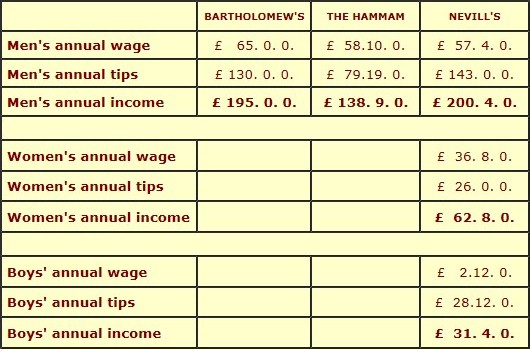
A quick glance at the table shows why the shampooers at the London Hammam were unhappy about there being a single pool divided among all the staff. It also suggests that Bartholomew's and Nevill's were competitively employing the same type of staff and competing for more or less the same type of customer.
If shampooers at the Hammam seem from this table to have been at a considerable disadvantage, there were compensations. First, the Hammam's reputation practically guaranteed their ability to get a job at any other Turkish bath in the country. Second, making continual contact with people at the 'highest' level of society brought considerable opportunities for private work outside the Hammam. Thirdly, the Hammam also distributed an annual Christmas bonus which has not been included in the table as it varied from year to year according to the company's profits. Finally, the company looked after its sick staff and frequently made payments to the families of deceased members of their staff.
This page reviewed and reformatted 02 January 2023
The original page includes one or more
enlargeable thumbnail images.
Any enlarged images, listed and linked below, can also be printed.
Shampooers' suggestions that tips are expected

Victorian Turkish Baths: their origin, development, and gradual decline



Comments and queries are most welcome and can be sent to:
malcolm@victorianturkishbath.org
The right of Malcolm Shifrin to be identified as the author of this work
has been asserted by him
in accordance with the Copyright, Designs and Patents Act 1988
© Malcolm Shifrin, 1991-2023