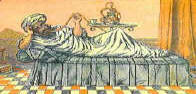
Barnabas Lett
In 1860 Barnabas Lett purchased a seven year-old open-air swimming pool with attached house belonging to a Mr F T Barber, added a small Turkish bath and opened it as a boarding establishment for people who wished to take a course of Turkish baths.
A contemporary poster offered boarding and use of the baths for two guineas per week. But it was also possible to use the baths alone for 2/6 for a Turkish and 1/- for a warm bath (First Class), or 1/6 and 6d respectively (Second Class ). Swimming in the pool cost 6d, both classes apparently able to mix quite freely without any noted risk of riots. There was, in fact, an unadvertised second class 'when the poorer classes were let in at a penny each, two hundred at one time'.
Swimming lessons, provided between 1872 and 1875 by the Turkish bath's masseur George Elson, were available at a cost of ten shillings for a course of eight, after which the pupil was guaranteed to be able to swim. Elson's account of his time at Sansome Walk (unlike his description of the work in his next post at Leamington) deals almost entirely with swimming activities, suggesting that the Worcester Turkish baths were not very busy during this period.
The Worcester Turkish, Swimming, and General Baths Co Ltd
This is confirmed in the prospectus issued by the proposed Worcester Turkish, Swimming, and General Baths Company Limited when, in 1875, they announced their acquisition of an 'interest in the business and certain fixtures and fittings' of the baths.
'The Swimming Bath, which in size and safety is superior to most of its kind in the kingdom,' it boasted, ' has hitherto been largely patronized.' But while it claimed that 'The merits of the Turkish Bath as a means of cleanliness and health are now fully recognized by the Medical profession, and by all classes…', there was no mention at all of the usage of the Turkish bath.
On 5 June, the newly formed company agreed to lease Mr Lett's baths at £30 per year, retaining him as manager, and also to lease for a further £30 per year, 'the fixtures, implements, and appliances, connected with the said Baths, as mentioned and set forth in the schedule hereto.'
The prospectus admitted that the present baths were 'devoid of those appointments which tend to luxury and ease' but argued that, since they were the only ones in the vicinity, they could be made to 'yield a satisfactory return' after some improvements had been made. No huge rewards were promised but it was hoped that 'many influential citizens will be induced to promote the undertaking by taking Shares rather from philanthropic motives than the desire of securing large profits.'
In fact the company was considerably under-capitalized as only 20% of the shares were taken up, and these were only part paid up. A clear indication of how small the establishment was at that time can be seen in the inventory of the 'fixtures, implements, and appliances' which the company leased for its £30 per year.
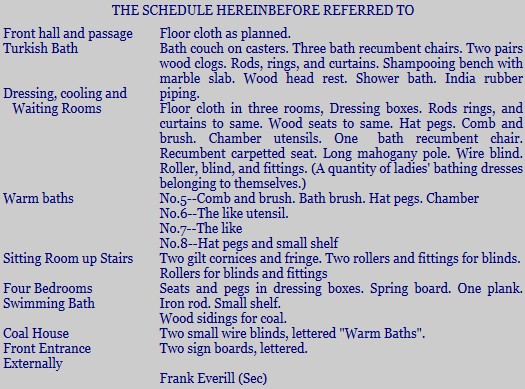
Judging from the of pairs of clogs available and the number of couches provided, it seems unlikely that more than about half a dozen bathers could have used the Turkish bath simultaneously. But even after spending nearly £500 on alterations to the premises and on new furniture and fittings, the company was unable to attract enough business to make a profit.
In the company's first year, the Turkish baths took £73.7.0 during the nine months in which they were open. The swimming pool and warm baths took a further £199.16.8 but that still left the company with a first year loss of over £25. Less than two years later the company's debts were such that it was wound up, and in 1877 the baths were sold to Charles Bartholomew.
Charles Bartholomew's Worcester establishment
Bartholomew had started his first Turkish baths in Bristol in 1859 gradually building them into a successful business. Fifteen years later, having made the decision to expand, he bought five new establishments between the years 1875 and 1882, altering and expanding each in turn till it met his own standards. Sansome Walk was the second of these new acquisitions.
Almost immediately he acquired the site to the north of the main house and by the end of 1878 had built a new Turkish and slipper bath suite there, while on the other side (on the site of Lett's original Turkish baths) he had added a new residential wing.
By now he was able to provide Turkish baths for at least a dozen bathers at the same time and had twenty rooms which could be let singly, or as two-room suites. Prices were reduced to 2/- for a single Turkish bath, or one pound for a course of twelve. After 5.00 pm these prices were reduced to 1/6 and 14/-. A two-room apartment could be had for a pound per week and this, as Bartholomew was wont to point out, in an area close to the tourist attractions of Malvern, Tewkesbury Abbey and Stratford-on-Avon ('only a few miles distant by rail').
Bartholomew, though in no way medically qualified, nevertheless called himself Medical Superintendent of the baths, advertised his availability for consultations by appointment (5/-), and had no hesitation in disparaging the medical claims of the nearby Droitwich Brine Baths where,
the mode of treatment adopted is the immersion of the body in the salt water for 20 minutes daily; the salt may produce a slight stimulant to the skin, but it is altogether erroneous for any one to suppose that a particle of salt passes through the skin, and acts chemically on the blood; and well it is for the patient that it does not, for a few grains would produce injurious results…it is not the salt therefore which produces the good, but the temperature of the water—yet how infinitesimal are the heat and benefit got here, compared to what can be obtained at the Turkish Baths.
When Bartholomew died in 1889, his executors sold the Worcester baths to William Park.
Park's Baths & Hydro Hotel
Bartholomew had appointed Park the previous year as Bath Attendant at his establishment in Edgar Buildings, Bath at a weekly wage of '25/- per week and perquisites.' Although this was very close to Bartholomew's Bristol base, Park was almost certainly manager in all but name, Bartholomew probably calculating that if he allowed Park to use the designation 'Manager' he would ask for a higher wage.
Park might appear to have been over-ambitious in wishing to purchase the Sansome Walk baths instead of the smaller establishment at Bath. But his decision was a shrewd one based on the fact that the former had separate baths for men and women. There was consequently no need to allocate either alternate days, or a lesser part of the week, for use by women bathers.
Ambition alone, however, does not purchase a thriving Turkish bath when one is earning but twenty-five shillings a week. Leonard Park says that his father, a staunch Methodist, was helped at the outset by a loan from Sir William Hartley, the Methodist philanthropist, after whom the former Hartley College in Manchester was named.
William and his wife Rebbeca took up residence in Worcester at the newly renamed Parks Baths thereby beginning a period of almost seventy years when they were owned or run by Park or his son Leonard.
Park, who revered Bartholomew as Bartholomew had earlier revered Urquhart, retained the general layout and facilities of the baths with their separate floor for the use of women bathers. The hydro adjoining the baths now contained only sixteen rooms (since the Parks retained four for their own accommodation), and Park continued to improve the facilities by, for example, the addition of central heating.
Park's prospectus offered separate rates for patients, from three to six guineas per week according to how many baths the patient took each day and whether additional massage or fomentations were required. Ordinary visitors and boarders were charged two guineas and even 'Commercials' were provided with supper, bed, breakfast and Turkish for 10/6.
Like his predecessor, Park was not medically qualified. Yet under his supervision (and supported by two pages of testimonials from past patients including a solicitor and two reverend gentlemen),
numerous patients from all parts of the kingdom who have been in residence for special treatment are unanimous in their appreciation of the benefits received, and testify to the remarkable cures effected in long standing cases of sciatica, lumbago, rheumatism and gout, and including liver and stomach troubles which have resisted, and remained unaffected by, other methods.
William's son Leonard became Assistant Manager in 1918 after he was demobbed from the Royal Air Force at the end of World War I, continuing in that position until his father retired in 1946.
The baths under Worcester City Council
At that time, the baths were compulsorily purchased by Worcester City Council who wished to provide their citizens with more modern swimming facilities. But it was to take another 25 years of discussion, opposition, and procrastination before this actually happened. In the meantime the Sansome Walk Baths continued as before, with Leonard Park appointed Superintendent, a position he held until his retirement thirteen years later.
In 1971, the council finally completed the building of the new Worcester Swimming Pool on an adjacent site and finally closed the original baths. William Park might well have been surprised to see the facilities in the new health suite which include a Turkish bath with two hot rooms, a steam room, sauna, rest room, plunge pool, massage facilities and a whirlpool. But he would have been especially proud to know that the suite was called Park's Hydro in his honour.
It was renamed again in 2008 after a refurbishment which removed the hot dry air rooms, leaving the hydro without a Turkish bath.