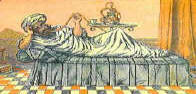
The hammam, or, The Islamic hammam

Courtesy of Pascal Meunier from his Hammams
There is, of course, nothing specifically Turkish about the so-called 'Turkish bath', any more than there is a unique type of English bath or American bath. For this reason such baths are more accurately thought of as Islamic hammams.
For it was (mainly) European 18th and 19th century travellers who—when they first came across public hot-air baths in the Ottoman Empire—labelled them Turkish, despite their widespread existence in the maghreb and wherever else there was, or had been, a Moorish or Islamic influence.
But the Islamic hammam was by no means the first hot-air bath. The basic hot-air bath had been in use in Sparta (and probably even earlier), reaching its zenith in Rome after the development of the hypocaust.
The dry hot-air bath, which was such an important part of the Roman thermae, survived only in the Eastern Roman Empire (the Christians in the west seeming to feel that if cleanliness was next to godliness, it was just as well to keep it a long way behind).
Under Islam, however, cleanliness 'is a religious duty to be performed daily by the believer in his ablution for the five daily prayers'. So hammams were actively promoted. They were often beautifully designed, and the cold plunge and swimming pools of the Roman thermae were replaced by fountains and smaller decorative pools, since naked bathing was firmly rejected by Islam. Massage, however, survived in a more developed form incorporating the shampooing process.
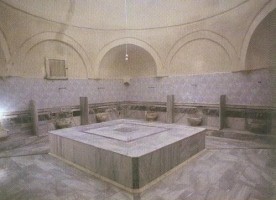
The Hacı Kadın Bath from Orhan Yılmazkaya's Turkish baths: a guide to the historic Turkish baths of Istanbul with photographs by Murat and Deniz Oğurlu
But whereas the Roman pools were separate from the hot rooms, in the hammam washing facilities were introduced into the hot rooms. Inevitably, the combination of hot air and cold water turned the original dry heat of the Roman baths into the misty, steamy atmosphere of the hammam, still to be found in Turkey today or, closer to hand in, for example, the north African owned hammams behind the Gare du Nord in Paris.
And the hot air in such establishments is not only humid, but often actually steamy, while the floors are frequently covered in water, as one would expect from the altered funtion of the hot rooms.