This is a single frame, printer-friendly page taken from Malcolm Shifrin's website
Victorian Turkish Baths: their origin, development, and gradual decline
Visit the original page to see it in its context and with any included images or notes

3. Women and the first Victorian Turkish baths
Any analysis of the ownership of Turkish baths by women is difficult to undertake with any degree of accuracy because information is not easy to find in any methodical way. We don’t know how many Turkish baths there were in total, and I have almost certainly underestimated the number open to women, but one can only take a view on the basis of the information currently available.
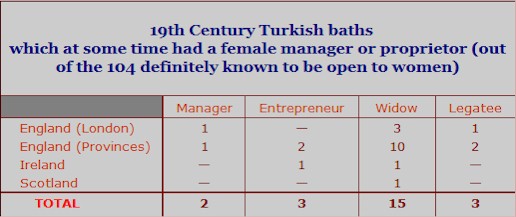
Turkish baths were considered quite respectable and their growing popularity coincided with the rise of the Joint Stock Company. So it is worth noting that women were among the shareholders in many of the hundred or so companies for which records survive.
Of our hundred-and-four baths, thirty-eight provided totally separate facilities in the same building, but with separate entrances, as in Nottingham (where they are side by side, with the women's entrance on the right) and London (where they are in different streets).
Sixty-four others provided separate sessions for women, on specific days, or at stated times (see Table).
Advertisements for separate women’s facilities, perhaps surprisingly, often emphasised that they were ‘under the supervision of Females’ or, if shared, that ‘none but females (specially instructed) are in attendance.’
So either proprietors felt it necessary to distance their establishments from the disreputable bagnios and hummums of the recent past, or they wished to stress that the therapeutic Turkish bath would be a comfortable experience; that women had no cause to fear the intrusions on their privacy suffered during visits to their male doctors.
Intrusions of a different kind clearly prompted an advertisement, in 1863, for the residential Matlock Bank Hydro which warned of a 10/6d fine for ‘Any gentleman entering the ladies’ bath-room.’
Only two Turkish baths, unconnected with an adjacent establishment for men, are known to have catered solely for women. One was near the Female School of Art in London’s Queen Square, about which very little is known. The other, was opened by Bradford Corporation in 1883, and closed thirteen years later through lack of use.
Many establishments, even those open to both sexes, were quite simple—a converted house or a shop; but a few were purpose-built, and rather more luxurious.
The Brighton Hammam, for example, was lavishly fitted inside with marble, coloured tiles, and fine woodwork. Its Alhambric hall was entered through red curtained Moorish triple arches, and furnished with divans ‘pillowed in damask and silk’.
The women’s baths on the first floor were smaller, had a separate entrance, and a cooling-room which was elaborately decorated and furnished, ‘feminine taste and elegance of disposition being, of course, considered and provided for.’
But elsewhere, pretty curtains and a dressing table were often intended to divert attention from the smaller size of the women’s baths, and the fact that not all the men’s facilities were matched in the women’s baths.
Air temperatures varied from establishment to establishment. Men’s hot rooms ranged from 120°F to 230°F. This might seem high, but the body can easily cope, provided the air is dry. Matilda Ellrington, a young servant who looked after Urquhart’s children, testified on oath that she had happily spent half an hour at 180°F in the Turkish bath at his Riverside home.
Women seemed to prefer slightly lower temperatures, but we don’t know why. Amongst men, there may have been a certain macho competitiveness to see who could bear the hottest room for the longest time—the least beneficial approach to determining the best temperatures.
This page revised and reformatted 02 January 2023
The original page includes one or more
enlargeable thumbnail images.
Any enlarged images, listed and linked below, can also be printed.
Entrance to Imperial Turkish Baths for Women, London
Cooling room at Edinburgh's Stafford Street
Brighton Hammam, converted later into a cinema
Men's cooling-room, Earls Court Gardens, London
Women's cooling-room, Earls Court Gardens, London


Victorian Turkish Baths: their origin, development, and gradual decline



Comments and queries are most welcome and can be sent to:
malcolm@victorianturkishbath.org
The right of Malcolm Shifrin to be identified as the author of this work
has been asserted by him
in accordance with the Copyright, Designs and Patents Act 1988
© Malcolm Shifrin, 1991-2023