The electric bath
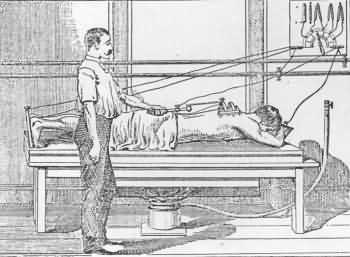
There were several different types of electric bath in use at various times, all of them being of little or no value at all. Fashion being what it is, however, when one proprietor added an electric bath to his facilities, others were sure to follow.
The one illustrated above is taken from Charles Bartholomew's Illustrated guide to the Turkish baths, medicated & other baths (published in 1887) and shows a set-up which he probably had only at his main establishment in Bristol. The patient lay on a slab which was warmed by a gas heater placed beneath. The electrodes were administered by an attendant.
The other type of electric bath had the patient lying within a bath of water while the (hopefully) low-voltage electricity was applied.
Bartholomew, to his credit, warned of the dangers of this type of bath and was fairly sceptical about its value. On the claim that it extracted metallic substances from the body of someone who was employed in a lead or metal works, he wrote,
Of such a power there is no evidence worthy of belief, and patients should be on their guard when such statements are made.
His adoption of the first type seems to have been solely for those patients who insisted on 'the electricity' in order to avoid using the water bath. But it was in use in such esteemed establishments as the Royal Baths in Harrogate, and within the Turkish baths suite on board the SS Adriatic.
More information on such baths can be found in E S Turner's delightful book, Taking the cure (London : Michael Joesph, 1967).